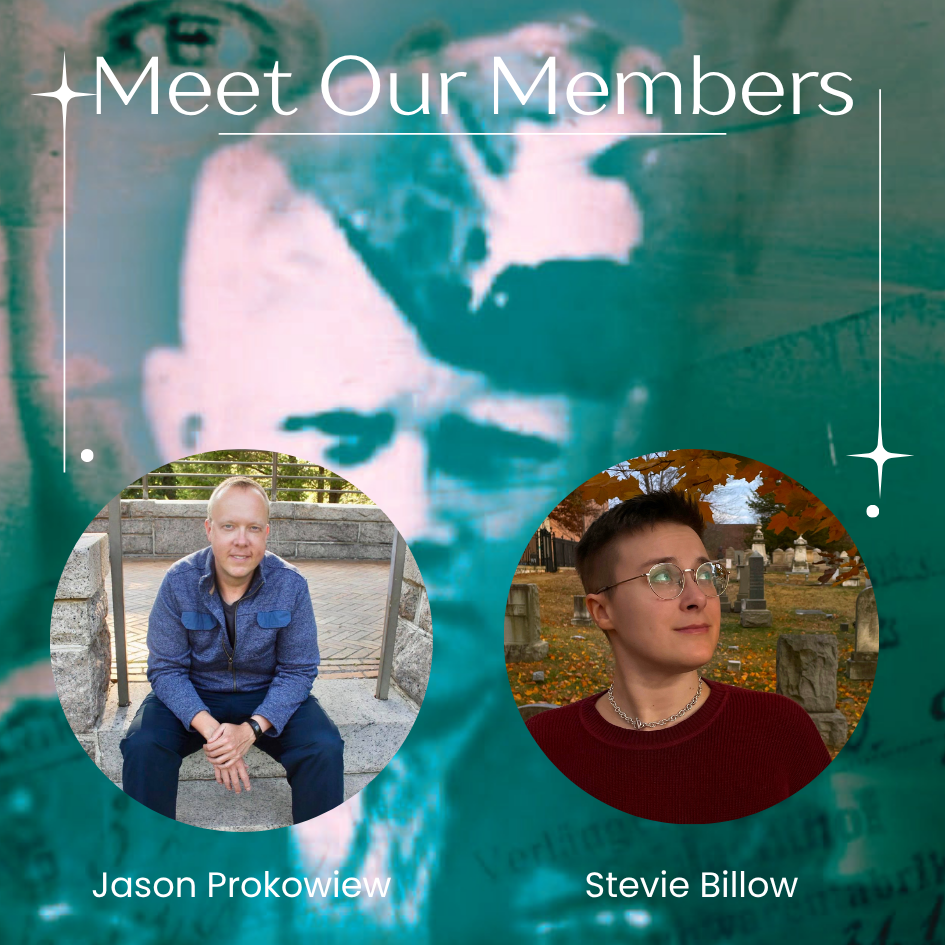
Welcome to member Stevie Billow’s continued interview series with Straw Dog Writers Guild members. This month Stevie interviewed author and member Jason Prokowiew.
Stevie: I’m delighted to interview you on behalf of the Straw Dog Writers Guild! Can you tell us a bit how you got involved with the SDWG?
Jason: I was fortunate to be an Edith Wharton & Straw Dog Writers Guild Writer in Residence at The Mount in 2024. That was my second year applying. In 2023, I visited the poet Cat Wei, a friend of mine from The Sundress Academy for the Arts residency and Bread Loaf Writers’ Conference, during her residency at The Mount. After getting a feel of Cat’s experience, I was determined to keep applying. Since my residency, I’ve acted as a judge for the residency, and been working with the SDWG on opportunities to share War Boys with the community. I’m very excited to be the featured reader at Writers Night Out at Forbes Library on October 6, an opportunity made possible by the Guild.
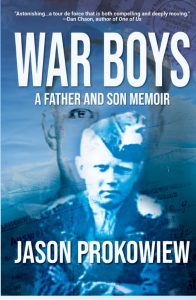
Stevie: Your forthcoming debut War Boys: a Father and Son Memoir (pubs July 1st 2026) has been in the works for over twenty years. How did this project start and how has your relationship to this manuscript shifted over time?
Jason: I took a course in Russian politics during my first semester at Oberlin College in 1998. I was 21 at the time. My professor showed us the Russian film Come and See, about the Nazi invasion of Belarus in 1941. The film reminded me of stories I’d heard my father tell, about his own experiences in Minsk after the Nazi invasion. I was drawn to my professor’s office to share how the film got to me and reminded me of stories my father had told. He asked me questions I couldn’t answer: what had happened to my father’s family? At the start of 1999, I visited my dad at his winter condo rental in Florida and begin recording what would become fifty hours of interviews with him about his experiences of war and with the Nazis.
There was the initial interview phase—my father and I finished our interviews in early 2002, a few months before he passed away. I earned my MFA in creative nonfiction between 2003 and 2006 where my thesis was War Boys, which was then called One Little Bolshevik. I’d come from a fiction background and was employing many fiction techniques to retell my father’s stories as creative nonfiction.
I continued with the manuscript until 2009, when I got an insurmountable case of writer’s block. I would have told you writer’s block was made-up before experiencing it. I’ve joked: like anyone with writer’s block would do, I went to law school. I spent the better part of 2009 through 2024 engaged in the study and practice of law.
In 2018, I revisited the manuscript and knew I was ready for it again. Between that year and 2025, I finished a first draft, then revised many times over, taking classes mostly at GrubStreet in Boston. The biggest shift in the work occurred in a year-long memoir class. Through that course and the ongoing process of adding my story and my reflections on my father’s abusive parenting, War Boys became what it is now: a braided memoir of my father’s history and my own experience of being raised by a parent traumatized by war.
Stevie: Your memoir is at once a family narrative and a work of historical biography. Can you tell us a bit about your research journey? How have broader, collective archives influenced your understanding of the very personal archive that is your father’s oral history recordings?
Jason: I encountered a lot of professorial adult naysayers, telling me when I was 21 or 22, that my dad’s story wasn’t real. Some would even say that my grandma probably wasn’t a high-ranking Communist Party member like my dad said. Spoiler alert: my grandma Valentina was that high up, and my father was correct.
Cut to 2006 and my first research trip to Belarus, where I spent time in the capital of Minsk where much of the action of War Boys takes place, in the city of Gomel where my father was born, as well as in my grandparents’ village of Novabelitsa. Before the trip, I found an organization called Family Tree Belarus that I worked with for the three weeks I was in the motherland. I came home with a broader understanding of myself as a Belarussian merely by being on the land that the Nazis and war had displaced my father from sixty years earlier, but also with documents that backed up my father’s “impossible” stories. For example, the archivists at the Minsk State Archive handed me a blood test that the Nazis administered on my father in 1943 that stated he had “German blood.” This is eugenics nonsense. The Nazi who employed my father needed to back-up his decision to employ and move my father into his home, rather than just kill him as a Russian and child of a Communist. They’d follow-up this blood test with further testing of his IQ, his skull, facial, and other physical features to label my father as a Volksdeutscher. My father said the Nazi doctor who made this final determination said it this way, “you are most likely German somewhere in your family’s past but at some point, your family was displaced into the backwards lands of Russia.”
I just finished a stint as a Fulbright Scholar in Germany. My father retreated from Belarus with the Nazis towards the end of the war and lived in Hamburg from about 1943 to 1949, first as a Volksdeutscher and then as a Displaced Person. One goal of my Fulbright research was to gain a broader understanding of the Volksdeutsche in Germany. I’ve come to understand that there were huge numbers of people deemed Volksdeutsche after Hitler came up with the designation in 1935. Some of my research, like finding my father’s blood work, is very specific to my father, whereas work like growing my understanding of Volksdeutsche, provides me with a broader picture of the world of War Boys.
Stevie: Who do you hope picks up and reads War Boys?
Jason: I hope that people who read about World War II and war generally pick up War Boys. I hope that survivors of war read War Boys. I hope that people who grew up with family with war trauma read War Boys and that they feel some part of their experiences reflected. I dedicated War Boys to the children of war, and I mean the first-hand survivors as well as their descendants. We all live with the echoes of war, and this world makes millions more war children all the time. I hope that survivors of childhood abuse and neglect read War Boys because I wrote it for them and to honor survivors. I hope Queer people read War Boys, because it provides a snapshot of what it meant for me as a Queer man to survive a community that didn’t welcome me. I hope that people who like incredible stories read War Boys. It’s unbelievable what my father survived, and anybody who likes a good story ought to appreciate that.
Stevie: War Boys is the Trio House Press 2025 Aurora Polaris Award winner–first off, congratulations! Can you tell us a bit about your publication journey? What’s it like debuting with a small press?
Jason: Thank you, it’s an honor to be the third winner after Deb Derrickson Kossman and Samina Najmi. I loved both of their books, Lost Found Kept and Sing Me A Circle, respectively.
In 2022 I signed with my first agent after receiving seven offers of representation. I admit, I signed with the agent who had made the biggest financial deals. He was also the only one who didn’t want to put much work into the manuscript before we submitted to publishers. We submitted widely in 2022. After twenty passes, my agent began ghosting me, all his enthusiasm for War Boys seemingly gone. After much contemplation, I fired him in spring 2023 and spent the next year and a half revising War Boys, with the help of two developmental editors.
In fall 2024 I started querying agents again with the revised War Boys. I think I queried something like 112 agents, the ones who responded often noted they didn’t want to touch a manuscript that had had twenty passes. Thankfully, three were still interested, and I signed with my current agent in November 2024. I submitted War Boys for the Aurora Polaris Award without telling my agent, not thinking anything would really happen from it. I learned I was offered the prize that spring, after Trio House’s publisher Kris Bigalk reached out to my agent to ask about acquiring my book.
I just came from my first AWP conference, where we sold early editions before publication in July. Trio House did a lovely job of giving my work moments to shine, but then I’d look around and see the spotlight move to another Trio House author’s book and I really appreciated both of these things happening.
Stevie: We’ve known each other for a few years now–the writing world is a small one! What role does literary community play in your life? How has literary community impacted War Boys?
Jason: I was trying to remember how I first met you. I know we were both residents at The Mount the same year, but I think I reached out to you before that because I knew you’d been a GrubStreet Emerging Writer Fellow. We’ve been in an online workshop together at Tin House (now McCormack Writing Center) and in person together at the Key West Literary Seminar, where we shared meals, a fun night at a Queer karaoke bar, and good conversation, especially about our work. I’ve always felt your support of me and War Boys, even if we aren’t in regular contact, as I feel the support of many in the community.
I think the writing community is one of the only communities that I’ve engaged with in my 49 years where I feel at home. Many writers are curious and open and doing work that catches my attention. I love that we’re all doing very different things but can commune about the often arduous task of bringing the work into the world. It’s not easy to write about child abuse and neglect, or self-harm and mental illness, or my Queerness or societal hatred of my fat body. I’ve found people willing to witness my experiences on the page and who are willing to help me make the writing better, without making judgments about my experiences. I’ll note that this isn’t always the case—there’s often someone in any workshop who doesn’t bring these tools to the table, but in the look-back, I hardly remember them. I learn from them too, about how not to be. I remember mostly in the look-back, the generosity of the other writers, and I learn from that how to be. It’s pretty amazing as a writer and person, to experience that.
Stevie: To send us off, do you have any advice for aspiring memoirists?
Jason: I wrote to my fellow memoirists in the acknowledgments for War Boys that “we’re often told ‘nobody buys memoir,’ do something else. From I Know Why the Caged Bird Sings to Stone Butch Blues to High-Risk Homosexual, I’ve learned about the breadth of human experience and been saved many times over. Please keep going. Please keep saving lives.” I wasn’t being hyperbolic. Books have saved me more than once. You never know who might need what you have to share in order to take a next step, to keep going. Please keep going. (And, be mindful of the naysayers—and that you’ll have to decide not to listen to them.)
Jason’s newest book War Boys is available for preorder here. The publication date is July 1, 2026.